Mombasa Chronicle
The Story of Fort Jesus
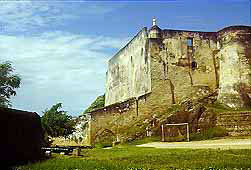
At the beginning of the story, the Fort belonged to the Portuguese, that is to say, they were the ones who built it. When they had fInished [its construction] they left a European called Migeli in charge. He remained there for a good many years.
Furthermore, the cause of the war was a vessel belonging to Sul- tan Qayd alArdh; the vessel, which was named QabaRa'8i, entered Mombasa harbour to obtain water. The ship lowered its launch so that it might go and fetch drinking water. The commander of the Fort, seeing what a fme launch it was, said to those on board, "Get out and give me your launch".
Those on board said to him, "We dare not hand over the launch; our Chief is yonder in the ship". The [por- tuguese] commander of the Fort did not agree with this and he took the launch, giving them a much smaller one in return, and they returned to their vessel. They gave the news to their Captain.
The Captain, who wanted his launch back, left his ship and said to the Portuguese, "Return it, for the launch is not mine; it belongs to the Imam Qayd al Ardh". The Portuguese replied, "We will not surren- der it. Be off! That is your safest course -but if you are looking for something else, we are ready"! The Captain sailed away, back to Muscat. He told the Imam what had taken place [in Mombasa] in connection with the launch.
Its sei- zure was a serious matter for the Imam, and he decided to declare war. His general, a Baluchi, said, "Don't wage war [yet]; send me fIrst incognito". So the Imam gave him goods [saying], "Go and trade in that country, so that you may know what the people are like and may come to speak their language, because then we shall know how best to approach them". The Imam accepted the advice of his man, whose name was Jumadari Ch'ota. He [ went to Mombasa and] traded there, becoming closely acquainted with the people.
To promote his plans he gave some of the money, in secret. [For quite some time] the Europeans were un- aware of what he was doing. In [the Fort there was one Christian and very arrogant man. Soon afterwards he summoned the townspeople. He said to them, "I want you to bring your people to fetch water for me."
The townspeople said "Insha'allah! We shall fetch the water [for you]". For two days the slaves n and the children were ordered to bring water. Amongst the young people bringing the water was an exceptionally beautiful girl in her early teens; the commander of the Fort took her by force, and de- flowered her .
The news reached her parents and the incident was regarded as a serious matter. All the townspeople met and told one another what had come to pass. They said, "What we must do now is to fight the Europeans and to evict them from the Fort. Their contempt for us has become intolerable".
Jumadari Ch'ota told them that they should not act in that way. He said, "It is not a small matter if you intend to fight these Euro- peans, it is a big one. I think you are not their equal; but I shall send you to [ one] who can indeed fight them. I shall take you and send you to him.
He shall come and shall take revenge [ on your behalf] .That man is the Imam Qayd al Ardh, who is a Muslim like you". They accepted his advice, saying "We agree, Jumadari Ch'ota". So he wrote a letter to the Imam Qayd al Ardh, telling him what had happened, [ as aforementioned.
Some volunteered to go] , and the Jumadar gave them someone who took them to Muscat. When they arrived there the Imam welcomed them joyfully, spoke sym- pathetically, and entertained them. He said, "Your wishes are granted". They stayed there for a few days, after which the Imam mustered a very large army. He despatched it to Mombasa together with the people who had come from there.
Now that is what the Imam did. Meanwhile, what Jumadari Ch'ota did was this. After sending those people to Muscat, he remained in Mombasa to arrange matters with his friends, who were waiting for [the return of] the people who had gone to Muscat. The year was 1086 [1674/1675]. The Imam's reply arrived together with the people who had gone to Muscat and with the soldiers.
Once the soldiers had arrived war was waged be- tween them and those who were in the Fort. So for nine years they fought a very great war. Almighty God enabled the Muslims to defeat the Europeans who The townspeople said "Insha'allah! We shall fetch the water [for you]". For two days the slaves n and the children were ordered to bring water.
Amongst the young people bringing the water was an exceptionally beautiful girl in her early teens; the commander of the Fort took her by force, and de- flowered her . The news reached her parents and the incident was regarded as a serious matter. All the townspeople met and told one another what had come to pass. They said, "What we must do now is to fight the Europeans and to evict them from the Fort.
Their contempt for us has become intolerable". Jumadari Ch'ota told them that they should not act in that way. He said, "It is not a small matter if you intend to fight these Euro- peans, it is a big one. I think you are not their equal; but I shall send you to [ one] who can indeed fight them. I shall take you and send you to him. He shall come and shall take revenge [ on your behalf] .
That man is the Imam Qayd al Ardh, who is a Muslim like you". They accepted his advice, saying "We agree, Jumadari Ch'ota". So he wrote a letter to the Imam Qayd al Ardh, telling him what had happened, [ as aforementioned. Some volunteered to go] , and the Jumadar gave them someone who took them to Muscat.
When they arrived there the Imam welcomed them joyfully, spoke sym- pathetically, and entertained them. He said, "Your wishes are granted". They stayed there for a few days, after which the Imam mustered a very large army. He despatched it to Mombasa together with the people who had come from there.
Now that is what the Imam did. Meanwhile, what Jumadari Ch'ota did was this. After sending those people to Muscat, he remained in Mombasa to arrange matters with his friends, who were waiting for [the return of] the people who had gone to Muscat. The year was 1086 [1674/1675]. The Imam's reply arrived together with the people who had gone to Muscat and with the soldiers.
Once the soldiers had arrived war was waged be- tween them and those who were in the Fort. So for nine years they fought a very great war. Almighty God enabled the Muslims to defeat the Europeans who were [humiliatingly] ejected from the Fort in 1094 [1683]. When Mombasa was taken it came under the Imam's control, and he appointed Jumadari Ch'ota, who remained in the Fort for three years.
After three years Jumadari Ch'ota, who became homesick, and in 1097 {1685/
1686] he applied for leave from the Imam. Then, afier this, the country changed hands and the Portuguese returned. Then Shaykh Mvita left his home-town, Shiraz, and came to I Malindi. He arrived with seven vessels. [Before reaching Mombasa, he coasted off Malindi, wanting to settle there.]
The people of Malindi said to him, "Here there is no room for you and your follow- ers to settle. Moreover, we are engaged in constant warfare with the Galla". They said to him. "Move on a little further, to a place called Kilifi; you will fmd it inhabited". They gave him a pilot and he went to Kilifi.
When he arrived [ at Kilifi] he was told what he had been told by the people ofMalindi -"There is no room here and you are a person of some standing. Go," they said, "to Mtwapa. That is a large town with many people; it will suit you". The people ofKilifi gave him a pilot who accompanied him as far as Mtwapa.
When he arrived [at Mtwapa] he wanted to settle. The people of Mtwapa said to him, "There is no room for you to settle here, in our place. We are at war with the Galla, with whom we usually fight twice a year". They said to him, "Further on there is an island called Mombasa, with a prominent rock. There you will fmd a place where j you can settle. Take this pilot that he may bring you there.
Near ! Mvita there is another town called Junda. Once you have arrived at 1the island you will meet people from Junda and all your require- 1 ments will be met". The people of Mtwapa gave him a pilot , , IV who accompanied him as far as the in-shore waters [offKisauni]. When he arrived at Kisauni Shaykh M vita said to the pilot, "[You I have done well!] I like this place and do not wish to leave it". His , , people disembarked and they settled there.
From Kisauni they built along the coast until they reached P'waa K'uu. Once he had estab- lished his settlement he wanted the people of Junda [to join him]. So ; they [all] lived together [in that place]. ' 1Afrika und t)bersee, Band 73/1- 1990 8 Afier three years Jumadari Ch'ota became homesick, and in 1097 [1685/1686] he applied for leave from the Imam. Then, afier this, the country changed hands and the Portuguese returned.
Then Shaykh Mvita left his home-town, Shiraz, and came to I Malindi. He arrived with seven vessels. [Before reaching Mombasa, he coasted off Malindi, wanting to settle there.] The people of Malindi said to him, "Here there is no room for you and your follow- ers to settle. Moreover, we are engaged in constant warfare with the Galla". They said to him. "Move on a little further, to a place called Kilifi; you will fmd it inhabited". They gave him a pilot and he went to Kilifi.
When he arrived [ at Kilifi] he was told what he had been told by the people ofMalindi -"There is no room here and you are a person of some standing. Go," they said, "to Mtwapa. That is a large town with many people; it will suit you". The people ofKilifi gave him a pilot who accompanied him as far as Mtwapa. When he arrived [at Mtwapa] he wanted to settle. The people of Mtwapa said to him, "There is no room for you to settle here, in our place. We are at war with the Galla, with whom we usually fight twice a year".
They said to him, "Further on there is an island called Mombasa, with a prominent rock. There you will fmd a place where j you can settle. Take this pilot that he may bring you there. Near ! Mvita there is another town called Junda. Once you have arrived at 1the island you will meet people from Junda and all your require- 1 ments will be met".
The people of Mtwapa gave him a pilot , , IV who accompanied him as far as the in-shore waters [offKisauni]. When he arrived at Kisauni Shaykh M vita said to the pilot, "[You I have done well!] I like this place and do not wish to leave it". His , , people disembarked and they settled there. From Kisauni they built along the coast until they reached P'waa K'uu. Once he had estab- lished his settlement he wanted the people of Junda [to join him]. So ; they [all] lived together [in that place].
[After the people of Junda had come] Shaykh Mvita ordered a boat to Bet out so that he might view the island. The boat proceeded [until] it reached Kilindini. When it returned, [Shehe Mvita] gave permission for five of the seven vessels to return. Then some non-MuslimB, Wasi, came- who were hunters.
Shaykh Mvita said to the Wasi, "Go into the town and observe it well". The Wasi went in to observe it. [They saw two large structures, the one a prison and the other a church] built by the Portuguese in the Fort; [and there was a dense] forest. They returned and gave him the information. Shaykh Mvita conferred with his people and said [to them]: "Let us leave them alone; let us not get to know one another; [for] if we do get to know one another [they are the people who are in the town - for the Portuguese were in the town] they will want to take us into the town; [ and if we enter we shall be humiliated -and we do not want humiliation".
Furthermore, after that, [the people ofMalindi] were attacked by the Galla who defeated them utterly and they fled from their Malindi homeland to Mvita. When they reached M vita some of them settled there, others went to Zanzibar, and yet others, the majority, went to Kilwa Kisiwani; others went to Msumbiji. After these events the people of Kilifi were attacked by the Galla, who defeated them totally.
They came to Mvita and, having reached there, Bwana Mungi's clan stayed in Mvita, and Bwana Shoka the Younger stayed in Mvita while Bwana Shoka the Elder went to Zanzibar. The remainder scattered along the Mrima coast. Also the Galla came and attacked the people of Mtwapa. They V fought fiercely and the Galla, who were defeated, went away empty- handed.
When Shaykh Mvita heard the news he Bent a messenger to the Shaykh of Mtwapa. When this messenger arrived the Shaykh of Mtwapa summoned his people and they took counsel. He said to them, "It is better for us to leave now rather than to wait for fmal defeat". They took his advice and went to Mvita. Furthermore when the four "tribes" met at Mombasa the Shaykh ofM vita spoke, saying, "There are Europeans in this country . If they gain power over us they
they will humiliate us.
The best thing to do is to send some of our people to Muscat, to fetch the Imam Qayd al Ardh, because when he comes and finds we are already here he will respect us". The people ofMtwapa formed an alliance with the Nyika, that is to say, with the Chonyi and Jibana; and the people of Kilifi formed an alliance with the Nyika, that is to say with the Ribe.
They went all the way to Muscat and informed the Imam Qayd al Ardh about the situation. /The Imam followed them and waged war/[1]. When they arrived there the Imam honoured them exceedingly. The Chonyi was given a pipe [to smoke] as a token of the contract between them; the Jibana was given a ring, and that was his contract; the Ribe was given a chair, and that was his contract.
The Ribe became their father because he had been given the chair .They travelled with the people [ ofMombasa] and returned to M vita. After they had dropped anchor at the harbour they sent a messenger with a letter to demand the Fort. The Europeans, who did not agree to its surrender, fought furiously.
When the spring monsoon arrived, the Arabs went home to Muscat. When they had arrived they told the Imam that the sea was far [from the Island of Mombasa]. "Our cannon balls fall short of the Fort". The Imam retorted, "Give me a description of the harbour", and they gave him a description.
He said to them, "Bide your time; let us wait for the arrival of the winter monsoon". When the winter monsoon of the second year arrived VI the Imam caused a large number of vessels to be loaded with dates. He said, "Describe the entrance to the harbour once again " , and they described it again. The Imam gave them sufficient quantities of dates. They came to Mombasa and did what they had been told to do by the Imam.
They threw more and more dates into the sea until the mound of dates emerged above the water and the water-line was below the dates. Then they mounted their cannon [ on the date mound] . They demanded the Fort, but the Europeans did not agree to surrender it. They fought one another until the end of the winter monsoon. The cannon used by the Europeans was more effective.
They returned to Muscat and apprised the Imam of the situation. The Imam said to them, "Never mind. Wait for the next winter 8. If they gain power over us they will humiliate us. The best thing to send some of our to Muscat, to fetch the Imam Qayd al Ardh, because when he comes and finds we are already here he will respect us". The people ofMtwapa formed an alliance with the Nyika, that is to say, with the Chonyi and Jibana; and the people of Kilifi formed an alliance with the Nyika, that is to say with the Ribe.
They went all the way to Muscat and informed the Imam Qayd al Ardh about the situation. /The Imam followed them and waged war/[1]. When they arrived there the Imam honoured them exceedingly. The Chonyi was given a pipe [to smoke] as a token of the contract between them; the Jibana was given a ring, and that was his contract; the Ribe was given a chair, and that was his contract.
The Ribe became their father because he had been given the chair .They travelled with the people [ ofMombasa] and returned to M vita. After they had dropped anchor at the harbour they sent a messenger with a letter to demand the Fort. The Europeans, who did not agree to its surrender, fought furiously. When the spring monsoon arrived, the Arabs went home to Muscat. When they had arrived they told the Imam that the sea was far [from the Island of Mombasa]. "Our cannon balls fall short of the Fort".
The Imam retorted, "Give me a description of the harbour", and they gave him a description. He said to them, "Bide your time; let us wait for the arrival of the winter monsoon". When the winter monsoon of the second year arrived VI the Imam caused a large number of vessels to be loaded with dates. He said, "Describe the entrance to the harbour once again " , and they described it again.
The Imam gave them sufficient quantities of dates. They came to Mombasa and did what they had been told to do by the Imam. They threw more and more dates into the sea until the mound of dates emerged above the water and the water-line was below the dates. Then they mounted their cannon [ on the date mound] .
They demanded the Fort, but the Europeans did not agree to surrender it. They fought one another until the end of the winter monsoon. The cannon used by the Europeans was more effective. They returned to Muscat and apprised the Imam of the situation. The Imam said to them, "Never mind. Wait for the next winter
We appeal for your donation for our charity
Comments and suggestions to improve this website
Your suggestions or concerns about our services
Please send you contributions.
Copyright© March 2003: The Waswahili Community Trust (UK)
Registered Charity:1083065
|